
Why We Invested in ARO Network: The Next Foundation for the Decentralized Edge
2025-07-29T17:38:04
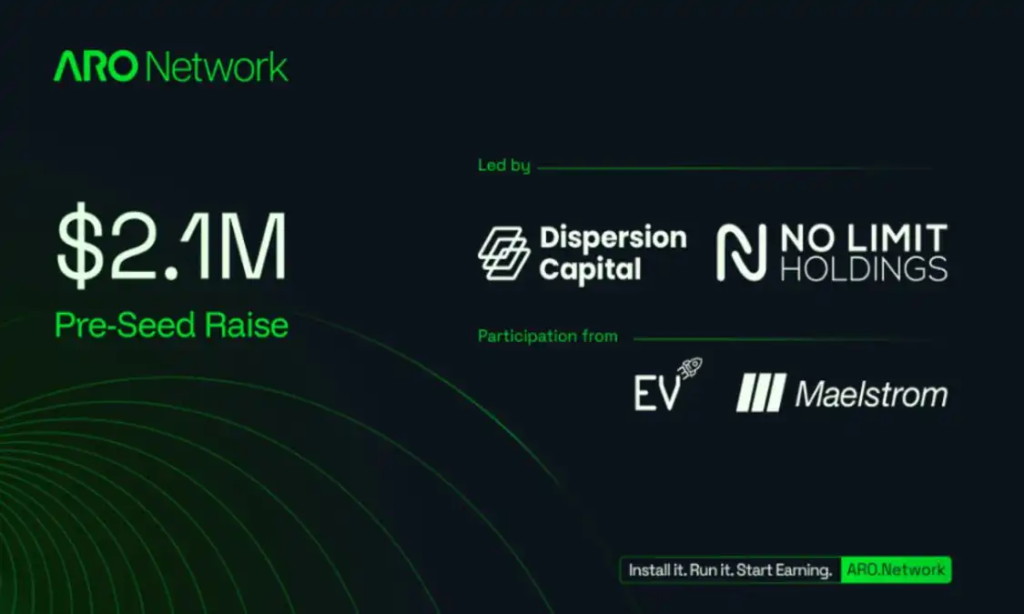
At Dispersion Capital, we’ve spent over a decade building deep technical conviction in decentralized infrastructure. This has never been about trends. It’s about systems. We specialize in infrastructure where decentralization solves real problems at scale.
Our roots in this space go back to 2014, when we backed Filament before DePIN was even a term. We believed in peer-to-peer industrial IoT before the market had a name for it. We supported Theta’s attempt to rethink video delivery. We helped grow Packet, a bare-metal edge compute platform that was acquired by Equinix, and Volterra, which F5 acquired to lead in edge orchestration. We were early supporters of Helium and FreedomFi, both of which helped Nova Labs reshape wireless infrastructure with crypto incentives and community participation.
These weren’t abstract theses. They were infrastructure bets with real-world traction. Along the way, we saw dozens of decentralized compute and CDN platforms fail. Many lacked runtime performance, coherent architecture, or a working incentive model. We passed on most of them.
What’s changed is the maturity of the market and the arrival of a platform that ties it all together. That platform is ARO Network (fka EnReach).
ARO fits directly into our thesis. We believe decentralized infrastructure will be the base layer for open AI, autonomous systems, sovereign content delivery, and programmable edge services. We’re entering an era where centralized hyperscalers are too expensive, too brittle, and too slow to adapt. The edge must be more than a concept. It needs to be programmable, verifiable, and ready for deployment.
ARO delivers on this. It’s not just a decentralized CDN. It’s a full-edge cloud system designed to handle real-world compute and content workloads with trust built into its architecture.
A Three-Layer Stack with Proof at Its Core
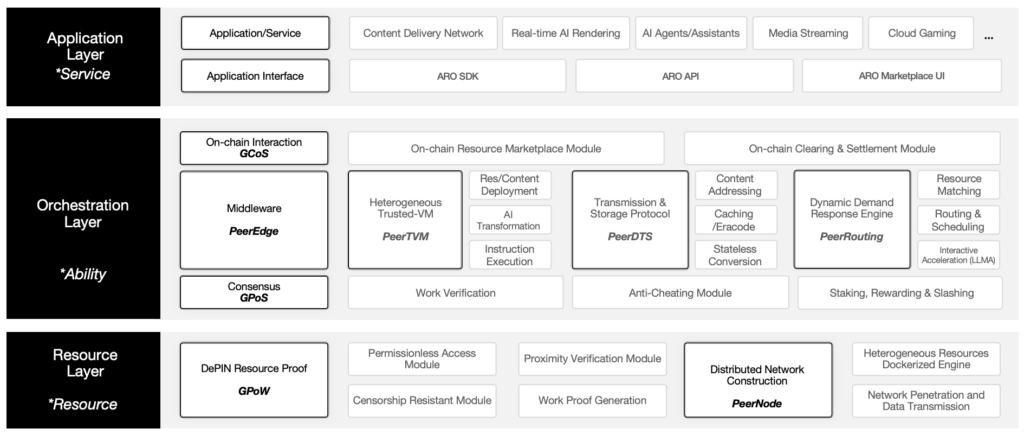
ARO’s stack is organized into three key layers: Resource, Trust, and Service.
- Resource Layer: Aggregates and virtualizes idle consumer and enterprise-grade hardware ARO Pods, routers, browser clients, and VM nodes—into standardized infrastructure. It abstracts heterogeneous environments into something uniform and callable.
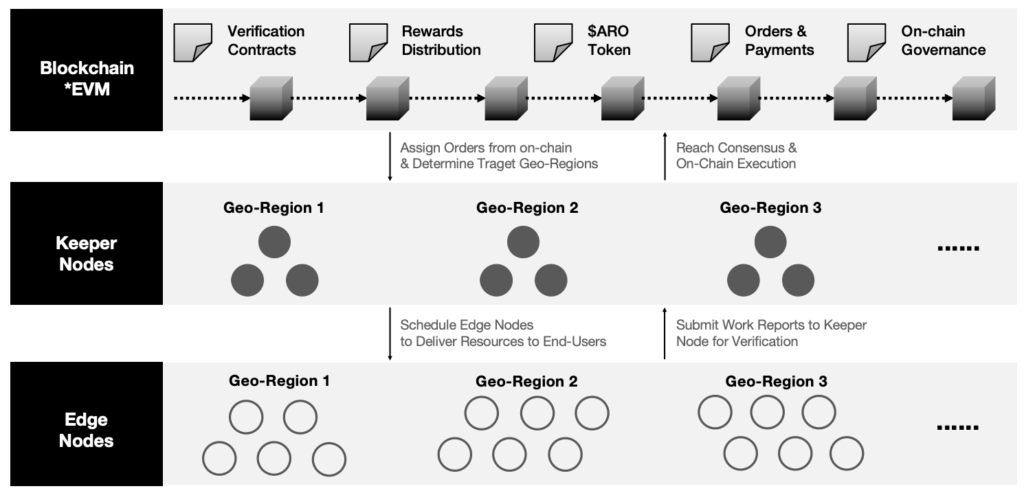
- Trust Layer: Uses Guarantee Proof of Work (GPoW) and Guarantee Proof of Stake (GPoS) to validate that work has actually been performed. Workload output is verified using TEE and zero-knowledge techniques. Keeper Nodes serve as decentralized validators, ensuring that claimed transmission, storage, or compute operations are real.
- Service Layer: Makes this infrastructure usable through PeerEdge, PeerHVM, and PeerRouting. PeerEdge handles deployment and orchestration. PeerHVM abstracts hardware into callable services. PeerRouting assigns jobs based on live network telemetry, not guesswork.
This system was built by a team with more experience in peer-to-peer content routing than nearly anyone else in the industry. It has powered millions of devices and driven over $140 million in previous real-world deployments.
Built for the Workloads That Matter
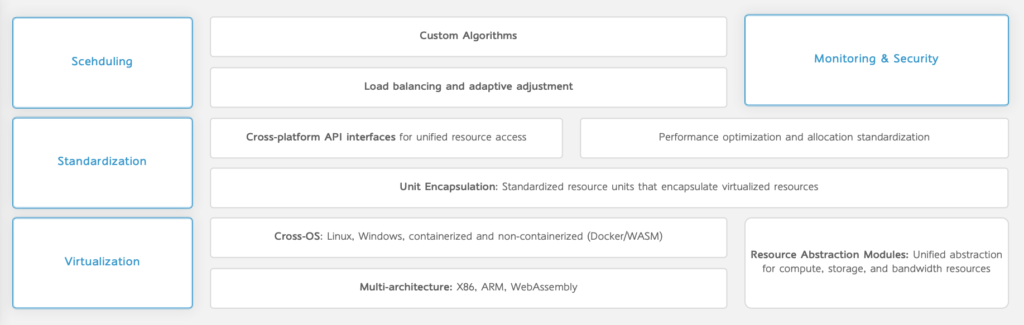
ARO focuses on the content and compute workloads that legacy cloud cannot serve efficiently:
- Peer-to-Peer Content Delivery: Through multi-source parallel downloads and replication, ARO enables low-latency, high-availability service across globally distributed, unreliable nodes.
- Content-Aware Routing: Built to handle APIs, personalized pages, and real-time content, ARO’s router intelligently forwards requests based on network congestion, latency, and cost. It is similar to Cloudflare Argo, but open and distributed.
- AI-Powered Content Processing: ARO’s transformer framework allows AI developers to deploy real-time models for translation, compression, filtering, and video enhancement. Processing happens at the edge, reducing roundtrips and improving responsiveness.
This architecture is designed for production. PeerTVM enables secure AI inference at the edge. Containers deploy across devices in varied environments. The network is coordinated using workload proofs that are enforceable, auditable, and cost-aligned.
Why This Matters Now
The cost of cloud is rising. Centralized systems are hitting geographic, latency, and performance ceilings. Emerging workloads AI inference, streaming, and interactive agents, cannot wait for a round-trip to remote data centers.
ARO is arriving at the right moment. The team has already demonstrated its approach at an internet scale. Now they are rebuilding it with stronger proofs, programmable orchestration, and incentives native to Web3.
Most decentralized compute platforms fail because they either:
- Cannot handle unreliable hardware
- Lack of enforceable workload verification
- Fail to match application demand with the right resource supply
ARO addresses all of this:
- PeerHVM standardizes compute across diverse devices
- GPoW and GPoS verify actual work, not just stake
- PeerRouting dynamically assigns tasks using real-time demand models
This is a blueprint for the next generation of infrastructure.
Beyond the Stack: What Comes Next
ARO’s roadmap is already in motion. The team is expanding its proof architecture, growing its node operator base, and onboarding early adopters who require performance and verification guarantees.
The broader opportunity is clear: enabling AI agents, sovereign applications, and localized compute at the edge not just in theory, but at a global scale.
This aligns with the core vision we’ve held for years. The future of the internet will not be centralized. It will be local, modular, trust-minimized, and open to all. ARO gives developers the tools to build toward that future.
We invested because it works. But more importantly, we invested because ARO represents a practical path toward real-world decentralization, one that delivers value now and scales with the demands of what comes next.
It’s more than infrastructure. It’s a new design for the internet: programmable at the edge, verified by software, and open to anyone with a device.
PreviewNet Launches: ARO is now onboarding early contributors to bootstrap the network and earn Jade rewards. Sign up through the Dashboard.
Hardware Pre-Orders Now Open: The ARO Pod is available for reservation. Order now via the ARO Pod eShop.